

So you just got born. It’s an eventful day and you are sent hurtling into this new world with a “travel brochure.” It has little boxes to check and a space to make your own boxes. Like this…
☑ You want fair? Ha ha ha.
☑ Messy? You got it.
☑ Marvelous? Yes people, the land, the sky.
☑ Monstrous? Yes people, the land, the sky.
☑ Sh*t happens? Yes.
☑ Green lights happen? Yes.
☑ Why me? Come on…why not.
☑ Nothing is a miracle…or…everything is a miracle. You decide.
☑ Second chances? Like every day…when you pay attention.
The cardiologist in charge of the whole cardiac team walks with me through the corridor leading from the emergency room to the heart catheter lab where they are rushing my husband on a gurney. “This heart attack is life threatening” the doc tells me as he turns right with Craig and points me straight ahead to “Maddy’s Room,” the designated crucible for people like me…who are waiting…waiting…waiting…for news about their loved one.
It looks like the surgical version of a jury pool. People are nervous, fidgeting with bags, doom scrolling on their phone, inhabiting this surrealist diorama as best they can. Kind of here, kind of not. I am the newest visitor to this pop-up ohana and am carrying Craig’s clothes in a big plastic bag. His wedding ring and wrist watch are stashed deep in my purse. Just an hour and a half ago I was setting up for my Thursday ukulele class on Zoom. And suddenly I’m sitting in seat number 14, grasping what looks like a medical bingo card, with Craig’s ID number scrawled across the front with a black sharpie. It’s my job to follow his progress on a big flashing technicolor screen by the receptionist’s desk: Arrival, pre-op, procedure, recovery…
Like many of us, my husband has medical issues, but heart problems…nope. So what happened? Craig was swimming laps at the local “Y” when he was jolted by an unusual pain in his chest. The lifeguard watched with concern as he got out of the pool. Was this just a muscle pull? Craig wondered. So he showered, but by the time he got home the first words out of his mouth were “I think I’m having a heart attack.” By then he was experiencing some shortness of breath, nausea and mild pain pushing down his left arm.
We got lucky. Very lucky. The pieces had to fit together perfectly and on this Thursday afternoon, they did. We also know it could have gone very bad, very fast. If I had called an ambulance they would have taken him to the nearest hospital. A big “NO!” The traffic lights were mostly green as I drove to the emergency room at UCLA in Westwood.
Despite a busy waiting room, they led him immediately into a small triage area where the ER doc, who reminded me of a svelte Santa Claus with a stethoscope, read the EKG and within seconds Craig was rolled to a giant triage room, surrounded by a dozen or so doctors, nurses, tech people, a gaggle of residents and fellows. This is a teaching hospital, after all.
From onset of symptoms to the insertion of two stents, it was about 90 minutes. Just under the wire. Craig was having a massive “widowmaker” heart attack. This is the big daddy coronary artery which feeds two-thirds of the heart and it was 100% blocked. Something like that is just about impossible to grasp. But a couple pictures? That’s a big reality check. The stent doc showed us the before and after images they took during the procedure. I’m telling you…there is nothing, no blood flow in that Left Anterior Descending Artery. But in the next image, the beautiful blood is back, like nothing had happened.
Decades ago, I worked in an emergency room, on the graveyard shift. Our staff consisted of one doc, two nurses, two orderlies, the radiology tech lady and me, the lowly admitting clerk. When things got crazy, which they sometimes did, I got in on the action because there was no one else to bring supplies, take nursing notes, hold someone’s hand.
In those days we kept family members away. But here I am, sitting in a spare folding chair by a portable x-ray machine, hearing every word spoken, watching this cardiac team work like an exquistely rehearsed ensemble of musicians. I feel strangely calm in this whirlwind of flashing lights, beeping sounds and scurrying bodies. Craig doesn’t look like someone in a lot of distress…considering. He is answering their questions. We are keeping steady eye contact with each other. So I am going with that calm feeling because, sometimes, denial is a wonderful thing.
🩷
In Maddy’s Room I am slowly welcomed into the corner-of-the room ohana. The gentleman next me has been here all day waiting for news about his wife. Brain surgery. A woman nearby brings him some energy bars and coffee from the cafeteria. “You really need this,” she says. He hasn’t heard any news since early morning and will still be there, waiting, long after I leave. He lends me his cable and adapter so I can charge my phone and we exchange emails, which is how I know his dear one survived the surgery.
Another woman apologizes for eavesdropping on our conversation but…she has to tell me that my husband will be okay because the cardiac department here at UCLA is the best. Gosh, is she psychic or something, but I am struck by her exuberant confidence. Her son, who is every inch a teenage boy–edgy, gangly, on the cusp of cute–is sitting next to her. “He has a heart transplant, this one,” she smiles.
I am old enough to remember that earthshaking day when Dr. Christiaan Barnard performed the first human-to-human transplant ever. In Cape Town, South Africa. Can you guess the year? It was 1967. Almost six decades later and this surgery is routine. Robotic procedures and immunotherapy are giving people more years to live. My husband is benefiting, at this very moment, from the breathtaking innovations in modern medicine. Of course we know how the story of life ends, for all of us, but what a bouquet of beautiful when our dear one gets a second chance.
We get a second chance too.
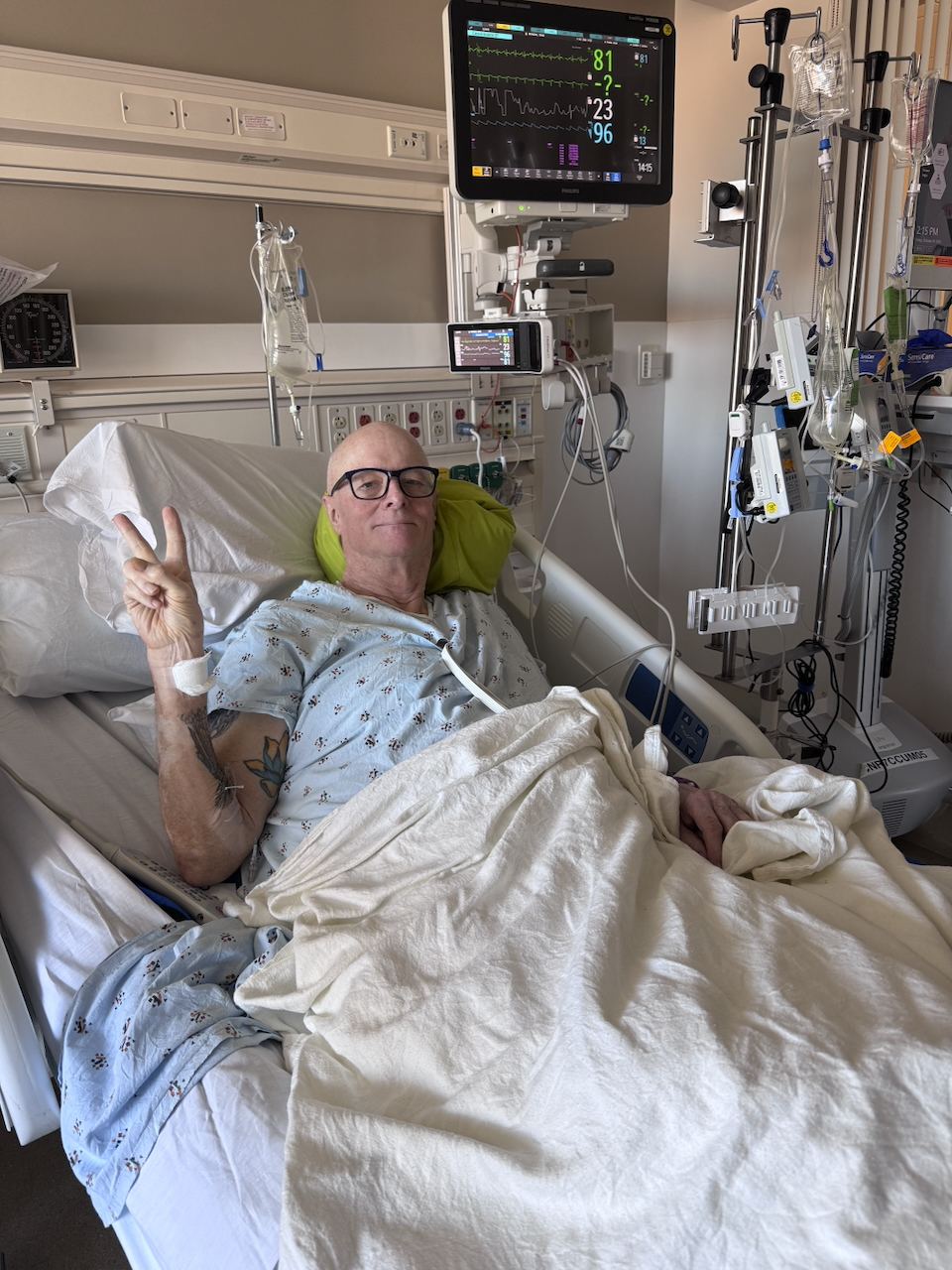
Later that evening, Craig is finally moved from recovery to the Coronary Care Unit where he is met by the cardiology team that helped save his life. Suddenly he hears a voice, “Mr. Brandau, is that you?”
Who is asking?
My husband was a beloved teacher at Venice High School where he taught world history for umpteen years. He saw terrific kids come and go including this one who is now a young doctor training to become a heart surgeon. “Thank you,” the guy in the lab coat says, “it’s teachers like you that made it possible for me to become a doctor.”
POSTSCRIPT
It’s been a month and Craig is doing better and better each day. When he’s tired, he rests. We call it a lay-down. I made a spread sheet of his medications — what each pill looks like, when you take it and what for. This is the medicinal recipe that’s designed (and tweaked) to help his heart heal. We won’t know how things are progressing until more tests down the road. But he’s feeling and looking mighty fine and getting with the groove at cardiac rehab.
Yes it’s really a miracle which is why I want to share my own heart story. To put things in perspective. Back in 2021, Craig and I made the same mad dash to the emergency room at UCLA, but this time it was for me. I was having very mild chest pain with indigestion, my breathing was a little huffy puffy, along with a woozy nauseated feeling. Even with severe Covid protocols in place, I was whisked away quickly because something was not right with my EKG.
When the muscle cells of the heart are stressed or injured, they release a specific protein that leaks into the bloodstream. Measuring the amount of this stuff, “troponin,” helps doctors assess the level of possible heart damage. The first test they ran on me came back normal: four. By that evening it had peaked in the eighties. I had an 80-90% blockage of the widowmaker. A stent was inserted. A couple days later I was sent packing with a bag of pills and a hot date at cardiac rehab.
In contrast, Craig’s initial troponin level was twenty thousand. By the time he left the cath lab, it was two-hundred thousand. When the Santa Claus ER doc stopped by later that night, just to check in and say hello, he said that most people with this kind of heart attack don’t make it out of the emergency room alive.
That’s a lot for anyone to wrap their mind around especially as life inexorably pulls us back into the piddly stuff of everyday “being here.” The memories? They slowly disappear into a dreamy haze.
So…let’s look at that brochure again…
🩷
“There are only two ways to live your life.
One is as though nothing is a miracle.
The other is as though everything is a miracle.”
Albert Einstein
Leave a Reply